
When transmission oil reaches the end of its service life, the transmission itself is also at risk. We recommend changing automatic-transmission oil every 60,000 km, or every 30,000 km for a sportier driving style.
Until now, automatic-transmission oil has often been changed mechanically: the old oil is drained, new oil is added and the filter is replaced. Unfortunately, this method removes only about one third of the oil; the rest remains, together with contaminants, in the torque converter, lines and other parts. Adding new oil to contaminated oil immediately reduces the quality of the new oil.
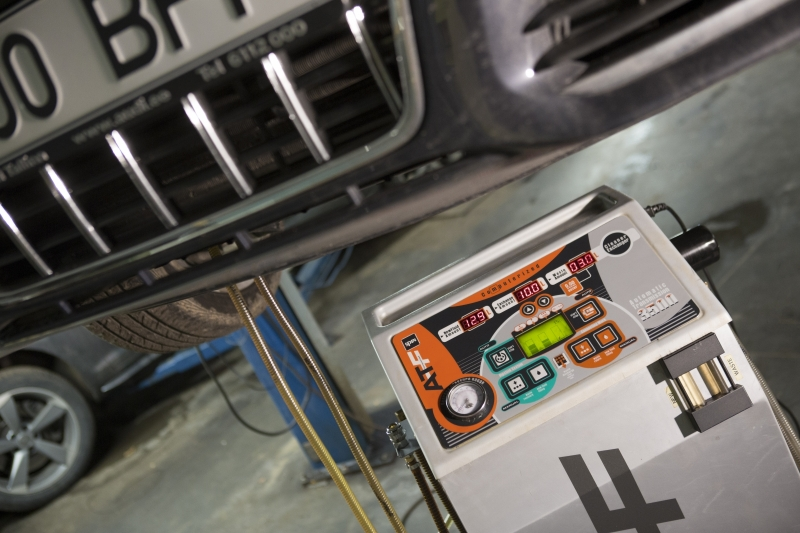
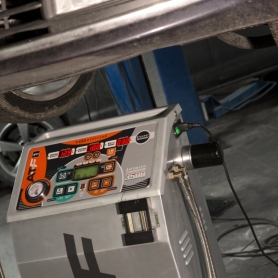
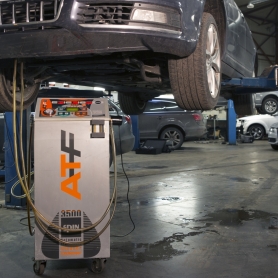
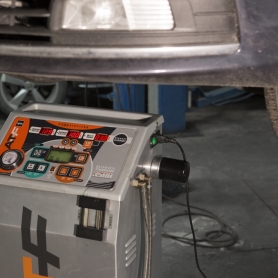
Flameko uses state-of-the-art equipment for transmission servicing and dynamic oil changes. Our equipment can flush and clean the entire transmission and replace all of the old transmission oil with new oil.
6 stages of dynamic transmission service and oil change
- First, a special cleaning agent is added to the transmission.
- Second, the existing transmission oil is flushed using our specialist equipment. The machine is connected to the automatic transmission's oil-cooling lines so that all circulating oil passes through the machine several times. The machine's filter removes contaminants from the oil and collects them in a trap. Flushing continues until the contaminants have been removed.
To remove adhered deposits completely, we add cleaning agents to the oil. A conventional oil change replaces only about one third of the automatic-transmission oil, leaving the torque converter, actuators, pump, lines and valves filled with old oil. Our equipment not only removes the oil from these areas but also thoroughly cleans the internal surfaces of the transmission components.
The equipment then pumps all oil out of the gearbox – including the entire pipework, torque converter and valves. We also check the gearbox oil pressure. - Third, the transmission's internal oil filter and sump gasket are replaced. During this work, residue is removed from the magnet and the transmission is checked for sealing. The cleanliness of the new transmission oil is fully ensured.
- Fourth, the transmission is filled with new automatic-transmission oil through the service equipment. The equipment precisely controls the amount of oil added and completely fills all transmission oil passages before the vehicle is started. The transmission operation is then checked.
- Fifth, the vehicle is taken for a test drive to check transmission operation. Afterwards the vehicle is allowed to cool for a couple of hours and everything is checked again.
- Sixth, an electronic basic setting is carried out so that the control electronics can adapt to the serviced transmission. Final adaptation takes place over approximately 100 km. During this period the customer can use the vehicle normally; the process is automatic.
Dynamic transmission service with specialist equipment is naturally more expensive, partly because more oil is required and no contaminated oil is left in the transmission. In return, the end result is significantly better.
The equipment also allows individual service stages to be performed separately, so the service can be tailored to the customer's requirements.
Ask for hinnapakkumist
 EN
EN  ET
ET